Our pick for booking: timed entry with audio guide, free cancellation up to 24 hours in advance. Book this See options
The Accademia Gallery was founded in 1784 by Grand Duke Pietro Leopoldo, along with the reorganization of the Academy of Fine Arts. From 2025 it is part of the Galleria dell'Accademia di Firenze and Musei del Bargello group, not the Uffizi. Between 2016 and 2024 many rooms were renovated: the Gipsoteca, Sala del Colosso, Byzantine rooms, first floor, musical instruments, 13th- and 15th-century rooms and the facade.
The museum is not as large as the Uffizi, and for this very reason it can be comfortably seen in a morning. Below are the must-see rooms, a possible route and some tips to avoid the busiest times.
The short answer
In addition to David, the Accademia Gallery deserves attention for Michelangelo’s four Prigioni and Saint Matthew, the Palestrina Pietà (of disputed attribution), Giambologna’s model of the Rape of the Sabine Women in the Hall of the Colossus, the gold-ground paintings, the Bartolini Gypsotheca and the Museum of Musical Instruments. A full visit usually takes about an hour, although the museum does not indicate an official time. The first morning slot is generally the quietest.
What not to miss at the Accademia Gallery?
David in the Tribuna, Michelangelo’s Prigioni, the Hall of the Colossus, the Bartolini Gypsotheca and the Museum of Musical Instruments. Those with more time can add the rooms with the gold-ground paintings.
In short, the main stops are:
- David’s Tribune: Michelangelo’s original, 517 centimetres of marble, beneath the skylight designed by Emilio De Fabris.
- Prisoners’ Gallery: four unfinished figures intended for the tomb of Pope Julius II, the Saint Matthew and the Pietà of Palestrina.
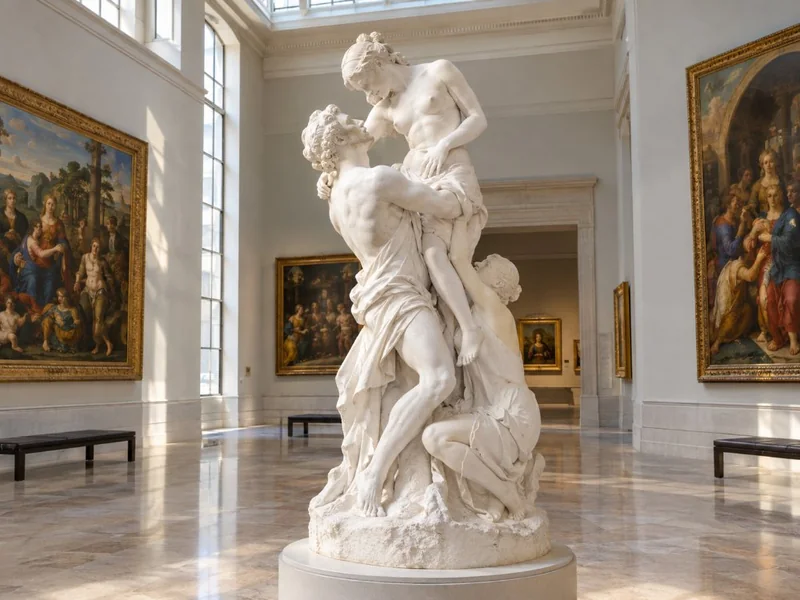
- Colossus Room: the full-scale model of Giambologna’s Rape of the Sabine Women.
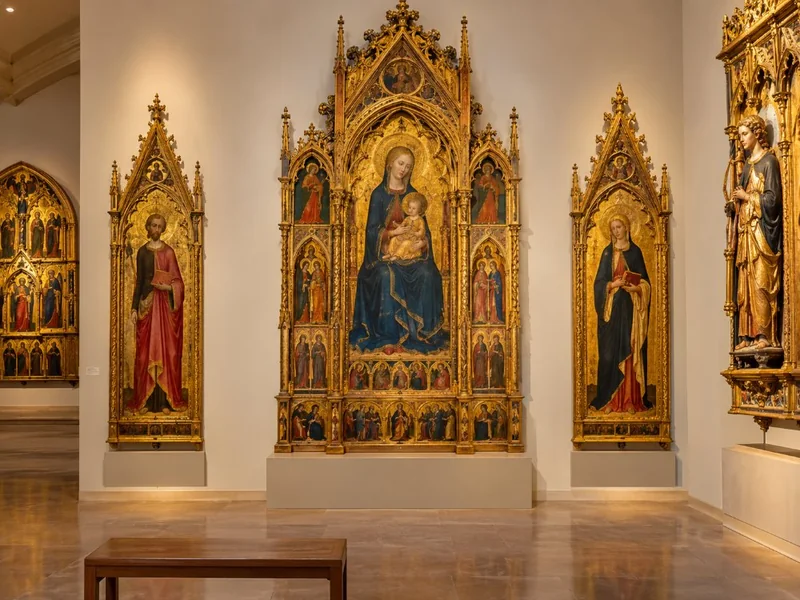
- Gold-ground Paintings: Florentine painting from the 13th to the 15th century.
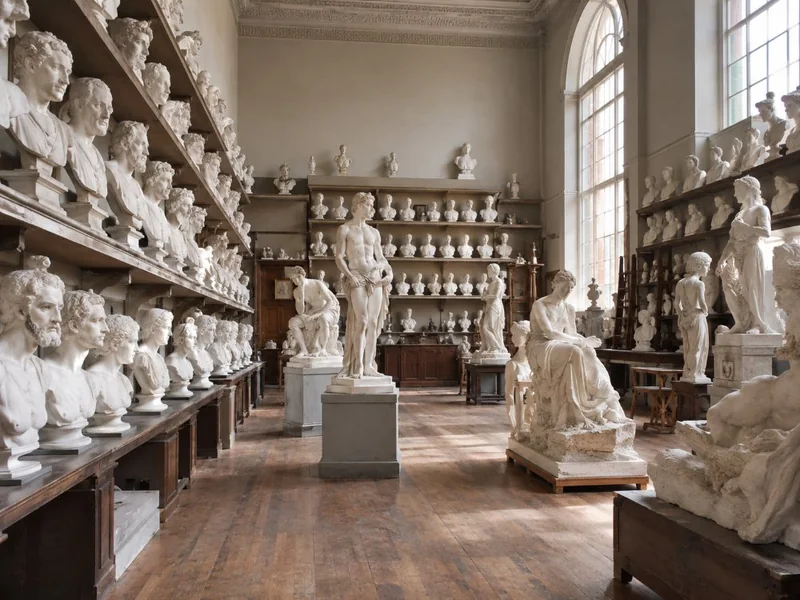
- Bartolini Plaster Cast Gallery: Lorenzo Bartolini’s plaster models and Luigi Pampaloni’s casts.
- Musical Instruments: around 50 instruments from the Medici and Lorraine collections.
Each of these rooms is described in the following sections, with a suggested route at the end.
What are Michelangelo’s Prigioni?
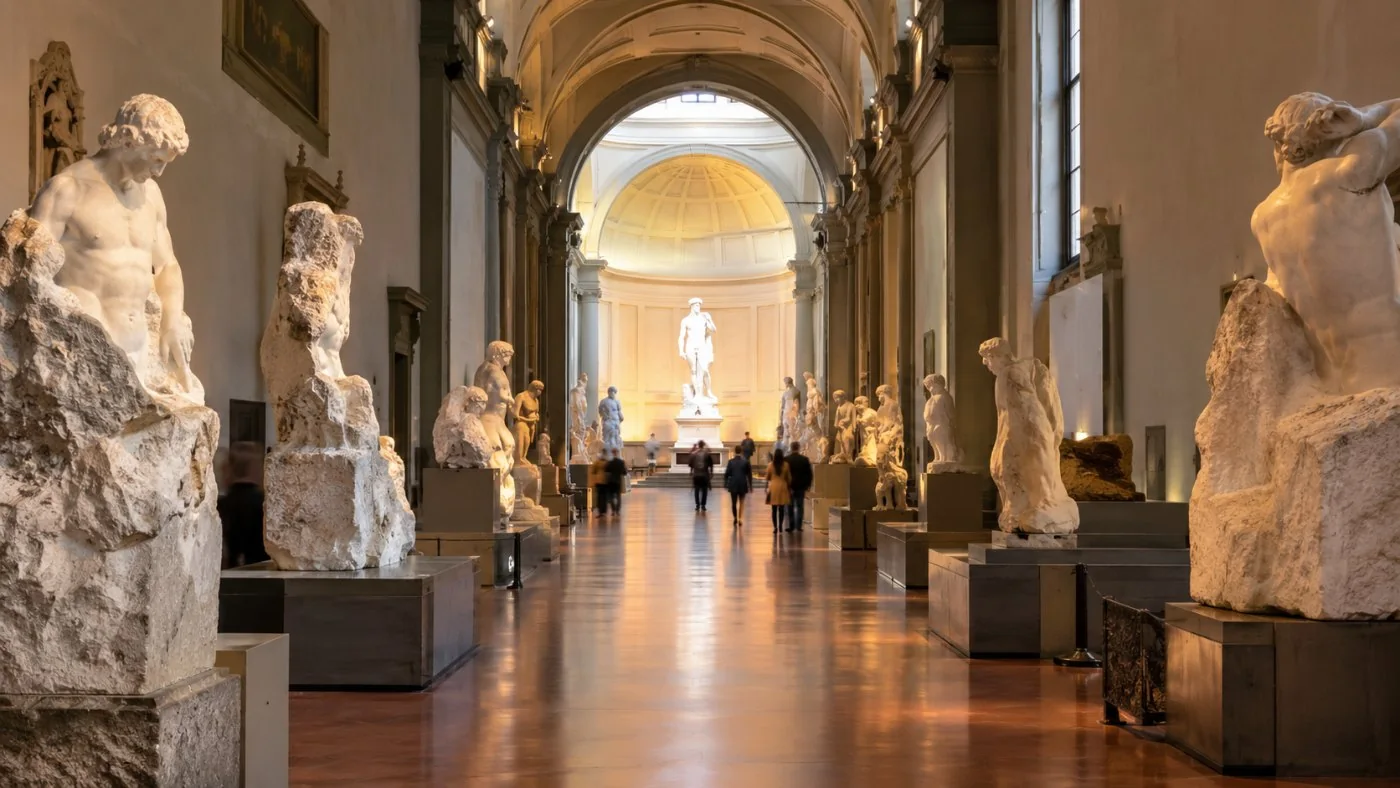
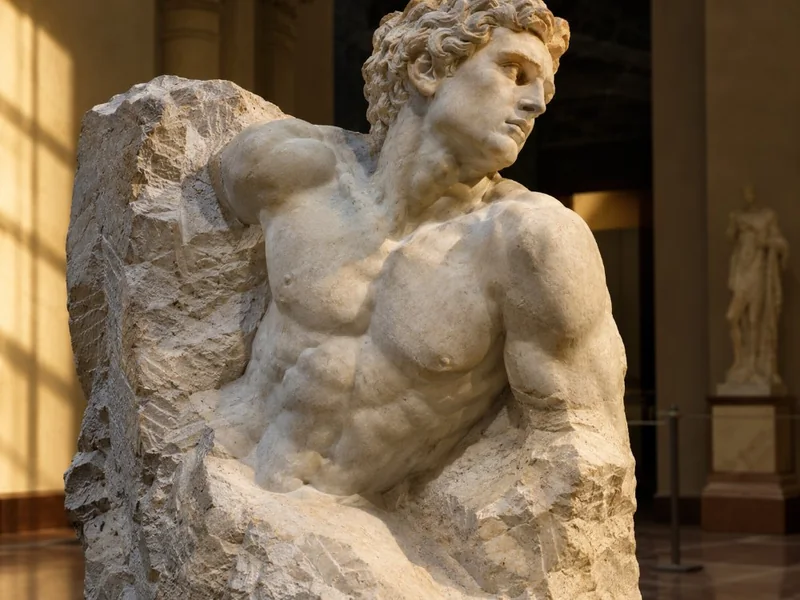
These are four large marble figures left unfinished, conceived by Michelangelo for the tomb of Pope Julius II. They are displayed along the gallery leading to David.
The Prigioni, also called Slaves, seem to struggle to emerge from the stone block: some parts of the body are fully worked, others barely sketched. Precisely because they are unfinished, they reveal how Michelangelo worked marble, removing material layer by layer. Many visitors find them more engaging than David itself.
In the same gallery you will find the Saint Matthew, also unfinished, and the Pietà of Palestrina, attributed to Michelangelo though scholars debate the attribution. It is worth walking through the gallery slowly before reaching the Tribune, then returning after seeing the David.
The audio guide covers the Prigioni, David and musical instruments at your own pace, in nine languages, with timed entry included.
Book thisWhat is in the Sala del Colosso?
The life-size model of Giambologna's Rape of the Sabine Women. The marble version, from 1582, is located under the Loggia dei Lanzi in Piazza della Signoria.
The Sala del Colosso has been renovated in recent years and houses the large preparatory model of Giambologna’s sculptural group. Sources disagree on the material, so it is best simply described as a life-size model. Around it are paintings from the 1400s and early 1500s on display.
Comparing the model with the marble is one of the small pleasures of a visit to Florence: after the Accademia, the finished group can be seen for free under the Loggia dei Lanzi, about a 15-minute walk away, next to the copy of David in Piazza della Signoria.
What are the gold-ground paintings at the Accademia?
These are gold-ground panel paintings from the 1200s to the 1400s, works by the so-called Florentine primitives. The museum also displays Renaissance paintings.
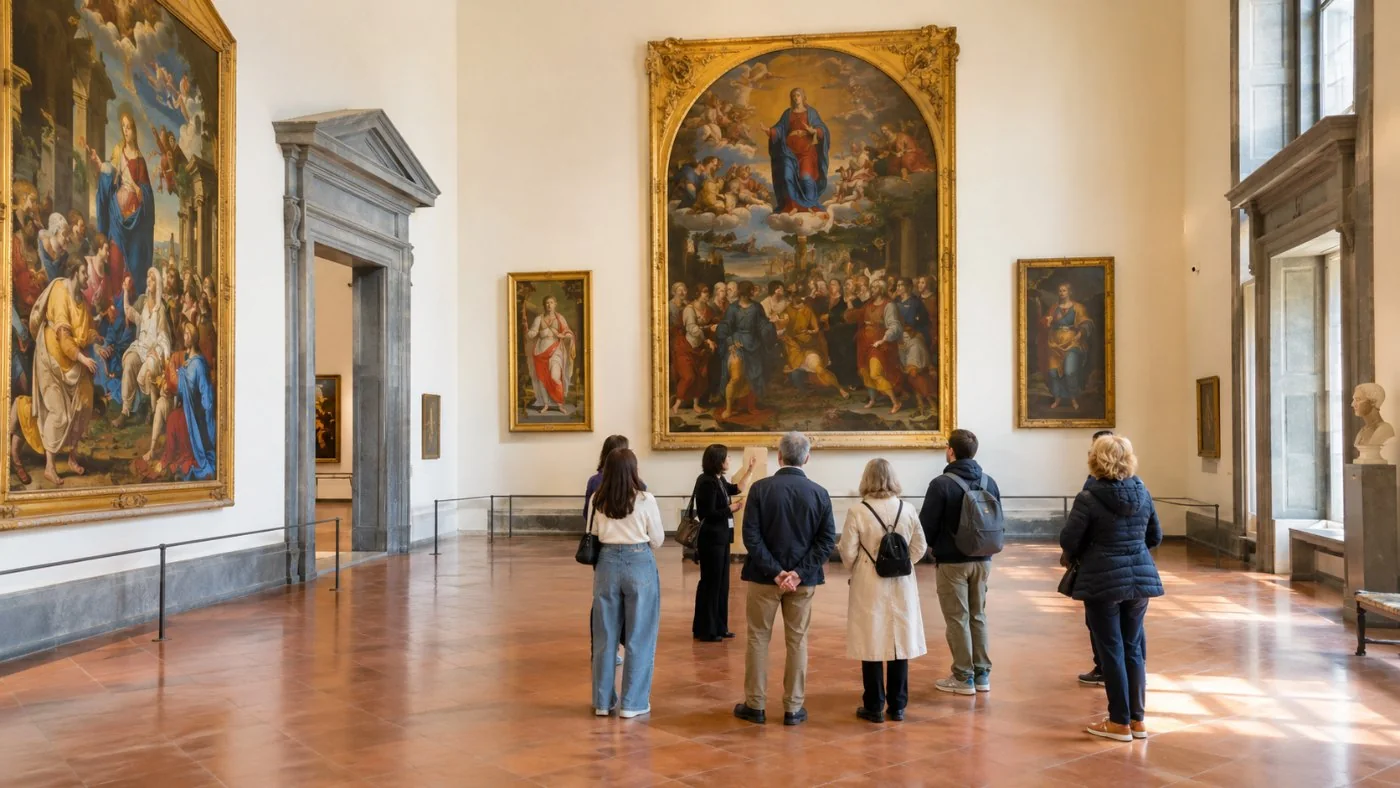
The rooms dedicated to painting from the 1200s to the 1400s were renovated between 2016 and 2024. Here you can see altarpieces and polyptychs with gold backgrounds, linked to Giotto’s school and 14th-century Florentine painting. Official sources also mention works by Botticelli and Ghirlandaio in the collections.
These are the rooms that usually have the fewest visitors, even during the busiest times. For art lovers, they are a good reason not to leave right after seeing David, and an opportunity to view important works at leisure.
What is the Gipsoteca Bartolini?
This is a room with plaster models by the 19th-century sculptor Lorenzo Bartolini and casts by Luigi Pampaloni, reopened after restoration.
The Gipsoteca is one of the most recognizable images of the Accademia: rows of white busts on the walls and large monument models in the center of the room. The small dark marks visible on many plaster pieces are reference points used to transfer measurements from the model to the marble.
After renovation work, the room is open to visitors again. It is a good place to understand how a 19th-century sculptor worked, in contrast to Michelangelo’s direct method seen in the Prigioni.
What is in the Museum of Musical Instruments?
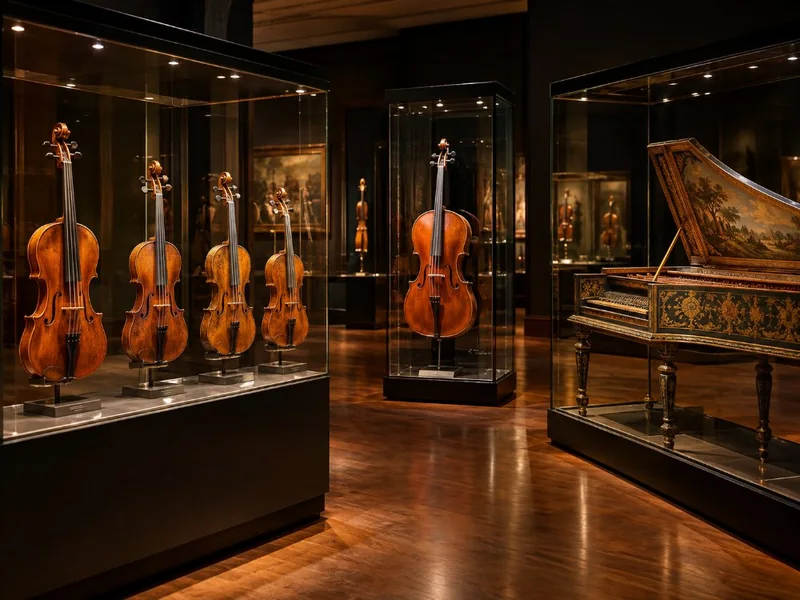
Around 50 instruments from the Medici and Lorraine collections, including pieces by Stradivari, an Amati cello and two instruments by Bartolomeo Cristofori, including the 1690 oval spinet.
The collection was established in 1926 at the Cherubini Conservatory and has been displayed at the Accademia since 1996. Among the most famous pieces:
- a tenor viola and a cello from 1690 by Antonio Stradivari, made for Grand Prince Ferdinando de’ Medici, and a violin from 1716;
- a cello by Amati from 1650;
- two instruments by Bartolomeo Cristofori, the inventor of the piano: the oval spinet from 1690 and one of the earliest vertical keyboard instruments.
A useful clarification: there is no Cristofori piano at the Accademia. The three surviving Cristofori pianos are in New York, Rome and Leipzig. What you see in Florence is the oval spinet, still a rare piece.
How much time do you need to visit the Accademia Gallery?
Usually about one hour, although the museum does not specify an official time. Those who linger in the gold-ground rooms and the instrument rooms may spend up to an hour and a half.
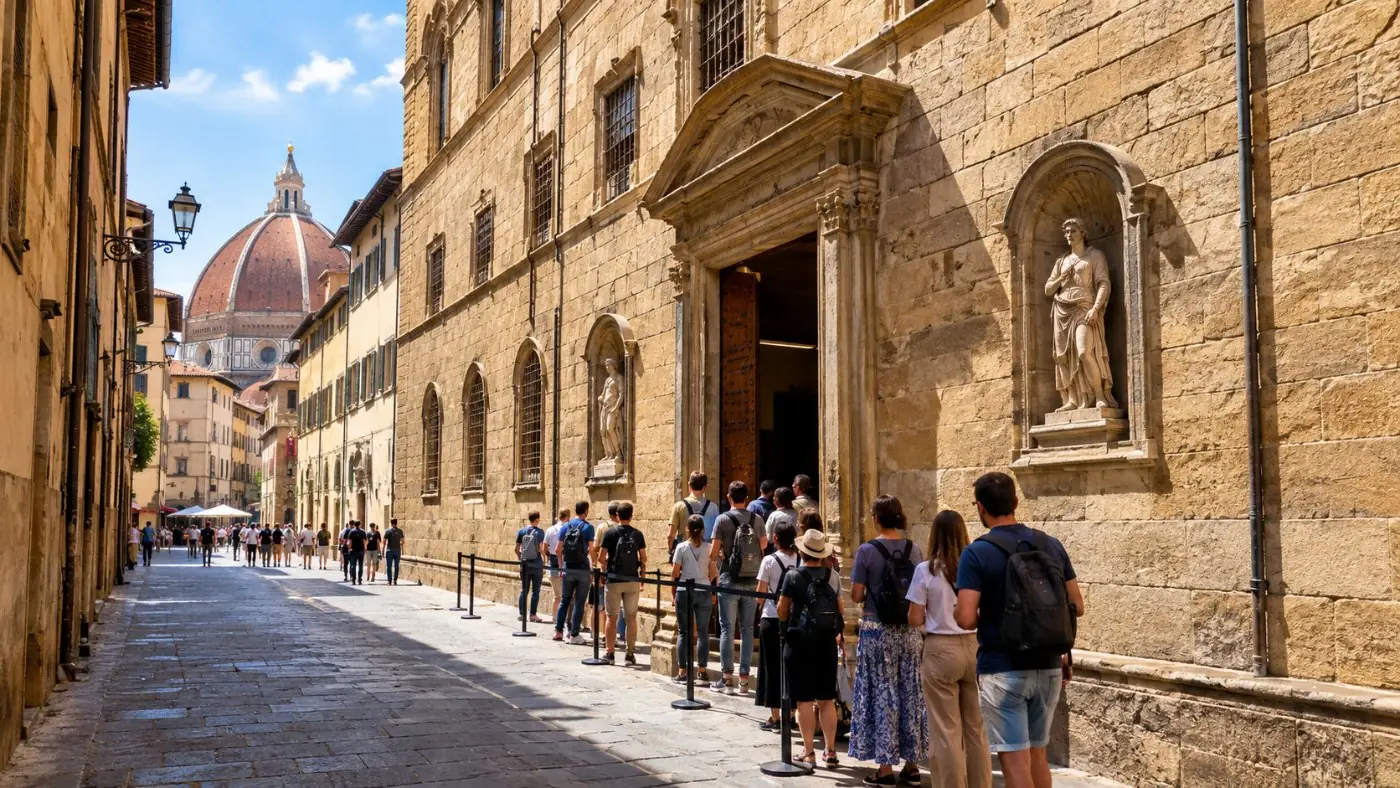
Travel guides generally suggest between 45 minutes and an hour and a half. With a timed ticket, you can stay in the museum after your entry slot until closing. The museum is open from Tuesday to Sunday from 8:15 to 18:50 and, according to the 2026 regulations, the last entry is 40 minutes before closing.
To see the rooms with fewer people, it’s best to book the first morning slot; winter months are generally quieter, while the first Sunday of the month, which is free and without reservation, has the longest queues. More practical tips are in the guide on opening hours and visit tips.
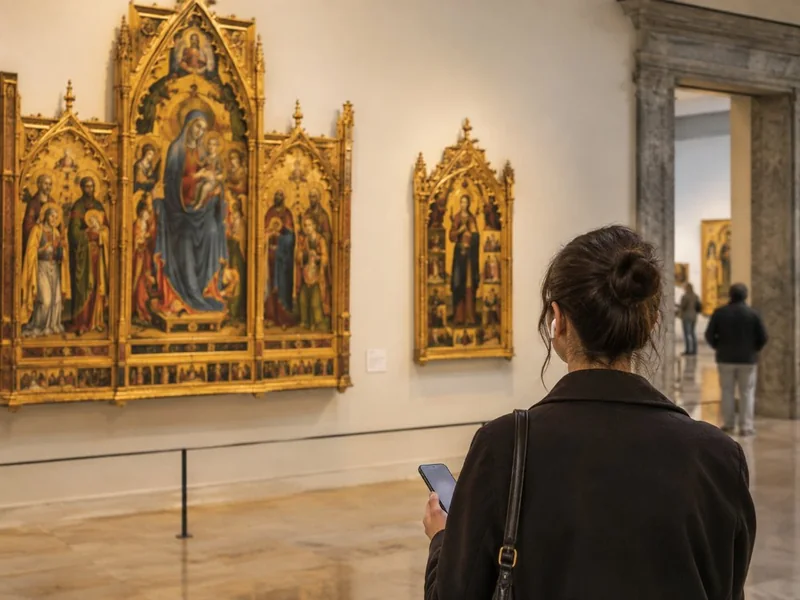
Timed entry with an audioguide in nine languages on your smartphone, headphones included: you visit at your own pace.
Book thisWhat is a good visiting route for the Accademia?
A possible order: Hall of the Colossus, Gallery of the Prisoners, Tribune of David, Gipsoteca, musical instruments and finally the gold-ground painting rooms.
A suggested route for about one hour:
- Sala del Colosso: a few minutes in front of the model of the Rape of the Sabine Women.
- Galleria dei Prigioni: the four Prigioni, the San Matteo and the Pietà di Palestrina, with David in the background.
- Tribuna del David: walk around the statue and observe it from a distance and up close.
- Gipsoteca Bartolini: the 19th-century plaster models.
- Musical instruments: Stradivari, Amati and Cristofori’s oval spinet.
- Gold-ground paintings: the quietest rooms, ideal for ending the visit.
Those entering with the first slot can reverse the order and go straight to David before the Tribuna fills up. A live guide usually follows a similar route: the 60-minute guided tour with timed entry starts at Via Ricasoli 39. For those who still need to buy a ticket, the ticket guide explains all the options.
Official timed-entry ticket for the first slot, to be collected at an agency near the museum: the route is chosen freely.
Book thisFrequently asked questions
Is Cristofori’s piano at the Accademia?
No. The Accademia houses Cristofori’s 1690 oval spinet and one of his vertical keyboard instruments. His three surviving pianofortes are in New York, Rome and Leipzig.
Where is the marble Rape of the Sabine Women?
Under the Loggia dei Lanzi in Piazza della Signoria, where it can be seen for free. The Accademia has the life-size model.
How many works by Michelangelo are there at the Accademia?
The David, the four Prigioni and the San Matteo. The Pietà of Palestrina is attributed to him, but the attribution is debated.
Is the Accademia Gallery part of the Uffizi?
No. From 2025 it belongs to the Accademia Gallery of Florence and Bargello Museums group, together with the Bargello and the Medici Chapels.
Ready to book
Choose your visit
Booking through GetYourGuide, with free cancellation up to 24 hours in advance.
Timed entry with audio guide
- Time slot reservation and entry ticket
- Audioguide app in 9 languages, with headphones and Wi-Fi to download it
- Voucher exchange at an office near the Accademia Gallery, depending on the option chosen
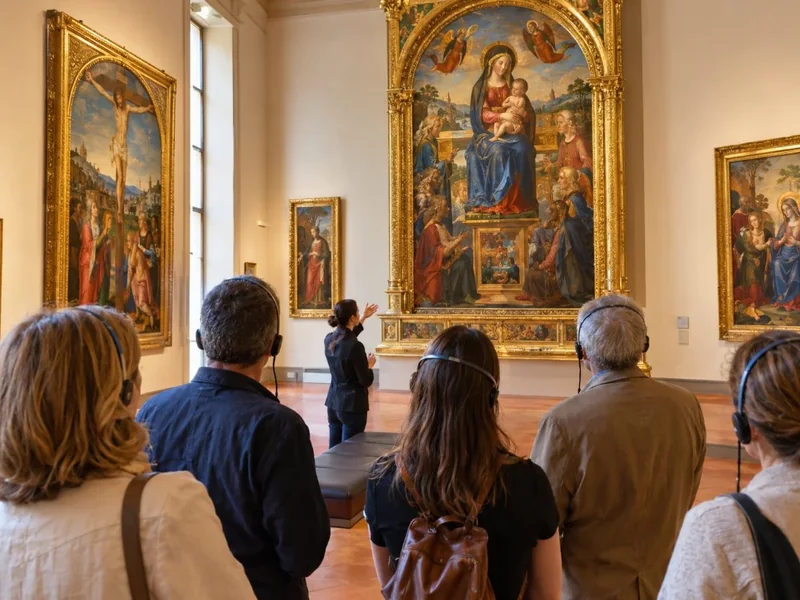
Guided tour of the Accademia with entry
- Live guide in Italian, English, German, Spanish, French or Portuguese
- Timed entry ticket and headphones
- 1-hour guided tour, then free time in the museum

Timed entry ticket for David
- Timed entry ticket, valid for all museum rooms
- Pickup at the office at Via degli Alfani 115 R, 10 minutes before the scheduled time
- Smartphone audioguide or virtual reality experience, only if selected in the option